


Gemini 4 Neon vs GPT-6.2 Astra for workflows — What the published evidence supports
Read the sources for the workload and conditions they actually describe. A model card characterizes performance in published evaluations. A launch announcement can establish when an option was introduced and where it started rolling out. A local trial should evaluate the task, implementation, and constraints your team expects to use.
Use a fixed set of source revisions. Require both candidates to produce a source map, a validated calculation, and a short brief. Insert a superseded estimate in the input packet and document which revision takes precedence. Review the handoff between source selection and calculation before reading the prose.
Sources: Google’s Neon announcement · DeepMind’s Neon model card · OpenAI’s GPT-6.2 launch and pricing
Define the decision and a passing result
A research operations team produces a decision brief after reconciling divergent source files and calculating totals.
Write one line that explains what a reviewer must see to accept the result. For this case, check correct handoffs, artifact integrity, and recoverability. Keep the success rule in the worksheet next to the input revision. A person reading the record should be able to tell why an output passed without being told which model produced it.
Use a routine version of the multistep brief case first. Then change one condition to make the easy answer invalid. The example to look out for is this: the final document is coherent but a calculation step used the superseded data file. Write the expected response before trying either candidate. Use a second, held-out input if you adjust the prompt after looking at the first result.
Run one comparison with identical instructions and file access, then a separate comparison in the environments your team actually uses. Record differences such as native imports, browsing, or execution access. This gives you a way to distinguish the effect of a model choice from the effect of an integration choice. Keep the two run types separate when reporting them.

Run the example on a fixed input
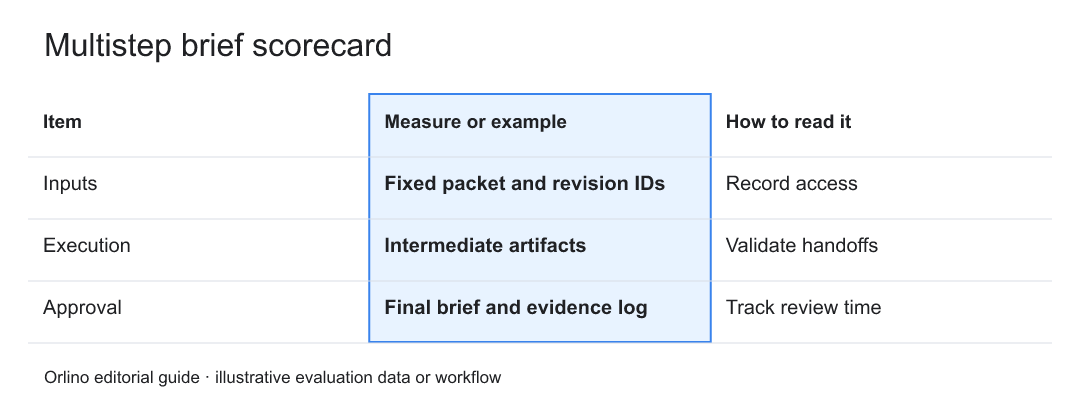
Require a source map, a checked calculation, an editable brief, and a log of unresolved discrepancies.
Record the path each candidate takes and the status of each intermediate artifact. If a step fails, grade the recovery separately. Some workflows are easier to supervise when a model produces clear intermediate outputs rather than hiding all work in a final response.
For the initial request, use this instruction as a starting point: “Require a source map, a checked calculation, an editable brief, and a log of unresolved discrepancies. Explain which input supports each consequential claim or calculation. List any required checks you could not perform, and state what would let a reviewer finish the job.” Keep the instruction with the saved run so reviewers can distinguish a missed requirement from an unstated expectation.
Save the first response, the correction history, and the final output. Record which important claims or actions a reviewer found unsupported. If the task relies on a tool, preserve the relevant tool result next to the output. A result awaiting a missing source belongs in a separate status from an accepted result. Include timeouts and abandoned attempts in the sample, since excluding them changes the denominator.
Before routing new work, set the default and fallback in writing. Specify what triggers a second attempt, what triggers a different model, and which outcomes require a person. A clear fallback can mean requesting missing evidence rather than spending more tokens on a guess. Record whether the extra attempt solved the actual failure or just produced a longer explanation.
Read the result and investigate misses
Keep tool configuration stable for the matched run. Follow with a separate trial of each model in the environment your team would use day to day. Report both because a realistic integration can matter even when the underlying model comparison has different constraints.
Use a small table with one row per task and candidate. Record the rubric outcome, severe defects, time to first response when it matters, time to an accepted output, and number of follow-up turns. Mark runs in which the tools or instructions differed. For repeated runs of the same task, retain every outcome and note whether the same issue returned. Treat a strong result on one sample as a reason to test it again on an independent case.
The final document is coherent but a calculation step used the superseded data file.
Keep a decision log with the workload, outcome, implementation dependency, and review date. For work that goes live, start with a narrow segment that can be reverted easily. Compare the results with the pilot and look for shifts in case mix. If the team no longer sees the improvement that justified the change, have a clear process for switching back.
Decide whether to adopt the workflow
Score each stage and the completed result, and report tool differences alongside outcomes.
A trial can show that one candidate performed better on your task without establishing that it wins on every task in the same category. Keep the original inputs and version information, and record which cases fall outside the trial. If both candidates fail the same requirement, look at what the inputs or tools expose before concluding that a larger model would resolve it.
Name the person responsible for reviewing the result and the date you will revisit it. Keep one accepted and one rejected sample as references. A future model revision, revised billing entry, or change in the input mix is a good reason to run the checks again. When the evidence supports only a narrow change, document the task that qualifies and keep the existing process for the rest.
Conclusion
Compare complete workflows using a single acceptance checklist. OpenAI and Google describe their models in separate release materials, which provide the basis for choosing a workload rather than declaring a head-to-head winner.
Score each stage and the completed result, and report tool differences alongside outcomes.
Frequently asked questions
What should I check first for Neon vs GPT-6.2 Astra for workflows?
Require a source map, a checked calculation, an editable brief, and a log of unresolved discrepancies.
How should I handle a failed example?
The final document is coherent but a calculation step used the superseded data file. Record the discrepancy and the relevant input or usage record. Require another run on a fresh case before changing the decision.
Can I apply these findings to another setup?
A trial can show that one candidate performed better on your task without establishing that it wins on every task in the same category. Keep the original inputs and version information, and record which cases fall outside the trial. If both candidates fail the same requirement, look at what the inputs or tools expose before concluding that a larger model would resolve it.
Keep reading
Gemini 4 Neon vs Hydrogen for everyday tasks
Gemini 4 Neon vs Hydrogen for everyday tasks. Compare the options on the same inputs and use a workflow checklist to decide when to switch.
Read article Gemini 4 NeonGemini 4 Neon: API cost of reviewing a PDF
Gemini 4 Neon: API cost of reviewing a PDF. Work through rates, billing assumptions, and the checks to make before estimating costs.
Read article Gemini 4 NeonGemini 4 Neon: reasoning benchmarks
Gemini 4 Neon: reasoning benchmarks — Explore reasoning benchmarks with a practical schedule revision example, checks for common mistakes, and a decision guide.
Read article