


Gemini 4 Neon: research and citation review — What the published evidence supports
Read the sources for the workload and conditions they actually describe. A model card characterizes performance in published evaluations. A launch announcement can establish when an option was introduced and where it started rolling out. A local trial should evaluate the task, implementation, and constraints your team expects to use.
Start the answer key with the official announcement and add the current product documentation as a separate entry. Record dates for both. A launch announcement may establish intent or rollout scope, while current documentation may answer what is available to a specific user now.
Sources: Google’s Neon announcement · DeepMind’s Neon model card
Define the decision and a passing result
An analyst checks whether a new vendor feature was announced, released, or available only to a pilot group.
Write one line that explains what a reviewer must see to accept the result. For this case, check primary-source coverage and exact claim support. Keep the success rule in the worksheet next to the input revision. A person reading the record should be able to tell why an output passed without being told which model produced it.
Use a routine version of the release verification case first. Then change one condition to make the easy answer invalid. The example to look out for is this: a secondary roundup says a feature is generally available while the official release says it is limited. Write the expected response before trying either candidate. Use a second, held-out input if you adjust the prompt after looking at the first result.
Prepare the evaluation in a sandbox or copy of the working files. Preserve the original form of the input alongside any text extraction, summary, or manual cleanup. If preprocessing is necessary, repeat it for each candidate and record whether a human or a tool performed it. Report the work required to prepare the input alongside the work required to approve the output.

Run the example on a fixed input
Require an evidence ledger with a URL, date, short supporting passage, and status for every consequential claim.
Ask the model to cite the governing sentence for the availability claim and label geographic, account, or platform limits. If the citation only links to a company’s home page, the source may be reputable but unhelpful. A brief should let a reviewer follow the evidence in a few clicks.
For the initial request, use this instruction as a starting point: “Require an evidence ledger with a URL, date, short supporting passage, and status for every consequential claim. Explain which input supports each consequential claim or calculation. List any required checks you could not perform, and state what would let a reviewer finish the job.” Keep the instruction with the saved run so reviewers can distinguish a missed requirement from an unstated expectation.
Save the first response, the correction history, and the final output. Record which important claims or actions a reviewer found unsupported. If the task relies on a tool, preserve the relevant tool result next to the output. A result awaiting a missing source belongs in a separate status from an accepted result. Include timeouts and abandoned attempts in the sample, since excluding them changes the denominator.
Have a second reviewer grade at least the ambiguous cases before resolving disagreements. Start with the answer key and the actual artifact. For an unexpected but valid answer, update the rubric in a new version and either regrade the existing sample or reserve the change for a later round. Preserve the original results so improvements in the scoring rules remain visible.
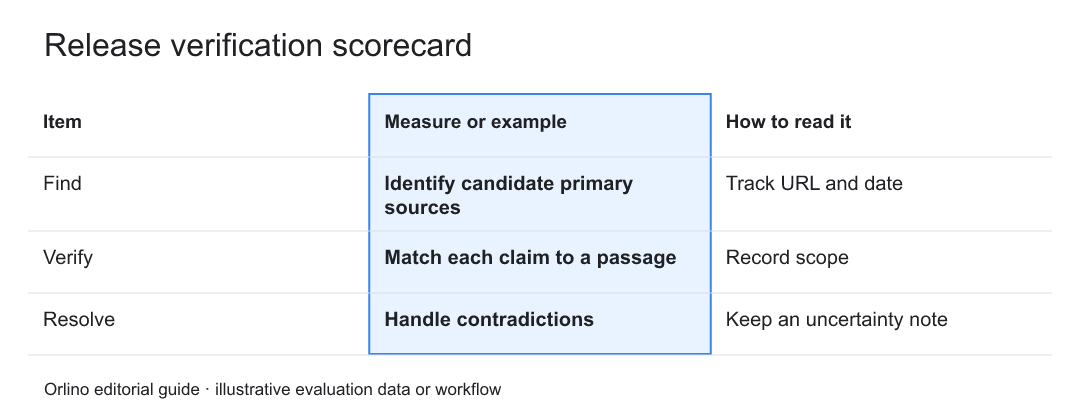
Read the result and investigate misses
Run a second case in which the sources genuinely disagree or describe separate versions of the product. Score whether the model explains the conflict without smoothing it away. Mark the claim unresolved when the evidence cannot support a single answer, and carry the uncertainty through to the recommendation.
Use a small table with one row per task and candidate. Record the rubric outcome, severe defects, time to first response when it matters, time to an accepted output, and number of follow-up turns. Mark runs in which the tools or instructions differed. For repeated runs of the same task, retain every outcome and note whether the same issue returned. Treat a strong result on one sample as a reason to test it again on an independent case.
A secondary roundup says a feature is generally available while the official release says it is limited.
Review critical failures on their own. Put errors with clear evidence in one column and disagreements about wording or preferences in another. If the trial produces a mixture of successes and failures, report cases where the workflow can already be used, along with the controls it needs. A single average can hide a serious error that occurs on a small class of tasks.
Decide whether to adopt the workflow
Check cited passages, resolve conflicts by source date and authority, and label unanswered questions.
A trial can show that one candidate performed better on your task without establishing that it wins on every task in the same category. Keep the original inputs and version information, and record which cases fall outside the trial. If both candidates fail the same requirement, look at what the inputs or tools expose before concluding that a larger model would resolve it.
Name the person responsible for reviewing the result and the date you will revisit it. Keep one accepted and one rejected sample as references. A future model revision, revised billing entry, or change in the input mix is a good reason to run the checks again. When the evidence supports only a narrow change, document the task that qualifies and keep the existing process for the rest.
Conclusion
Evaluate source discovery and citation support independently. A credible research brief should distinguish primary evidence from a quotation copied by an intermediary.
Check cited passages, resolve conflicts by source date and authority, and label unanswered questions.
Frequently asked questions
What should I check first for research and citation verification?
Require an evidence ledger with a URL, date, short supporting passage, and status for every consequential claim.
How should I handle a failed example?
A secondary roundup says a feature is generally available while the official release says it is limited. Record the discrepancy and the relevant input or usage record. Require another run on a fresh case before changing the decision.
Can I apply these findings to another setup?
A trial can show that one candidate performed better on your task without establishing that it wins on every task in the same category. Keep the original inputs and version information, and record which cases fall outside the trial. If both candidates fail the same requirement, look at what the inputs or tools expose before concluding that a larger model would resolve it.
Keep reading
Gemini 4 Neon: spreadsheet analysis review
Gemini 4 Neon: spreadsheet analysis review. Assess published benchmarks and use a practical checklist to verify results on your own tasks.
Read article Gemini 4 NeonGemini 4 Neon: switching from Gemini 3.5 Flash
Gemini 4 Neon: switching from Gemini 3.5 Flash. Compare the options on the same inputs and use a workflow checklist to decide when to switch.
Read article Gemini 4 NeonGemini 4 Neon: tool use and recovery
Gemini 4 Neon: tool use and recovery. Assess published benchmarks and use a practical checklist to verify results on your own tasks.
Read article