


Record each source's date and participant count
We selected Deep Research Expert in the installed Orlino desktop app and supplied the notes. Source A, dated October 1, reported 24 participants. Source B, dated October 3, reported 30 without explaining the difference. Source C, dated October 4, repeated A and explicitly credited it; C supplied no independent observation.
We asked for a ledger of each source's date, claim, independence and limitations, using only those excerpts. The reply also needed to explain the unresolved conflict and ask three verification questions.
Mark source independence as unknown when unproven
The first reply kept both counts and correctly treated C as dependent on A. It also labeled B independent, although the notes gave no relationship between A and B. A was treated as a presumed primary source without evidence of its origin.
We asked Orlino to mark independence as unknown for A and B, keep C's explicit dependence, and preserve the dates and counts.
The revised ledger did that. It also rejected recency as a way to settle the discrepancy. B's October 3 note was later than A's October 1 note, but it didn't establish whether 30 was an update, a correction or a count of the same population.
Put the idea to work.
Try the workflow with your own material in Orlino.
Turn conflicting claims into verification questions
The first answer had also proposed finding six disputed individuals. The difference between 24 and 30 is six; it doesn't identify six particular records. The counts might use different populations, definitions or cutoffs, none of which the excerpts explained.
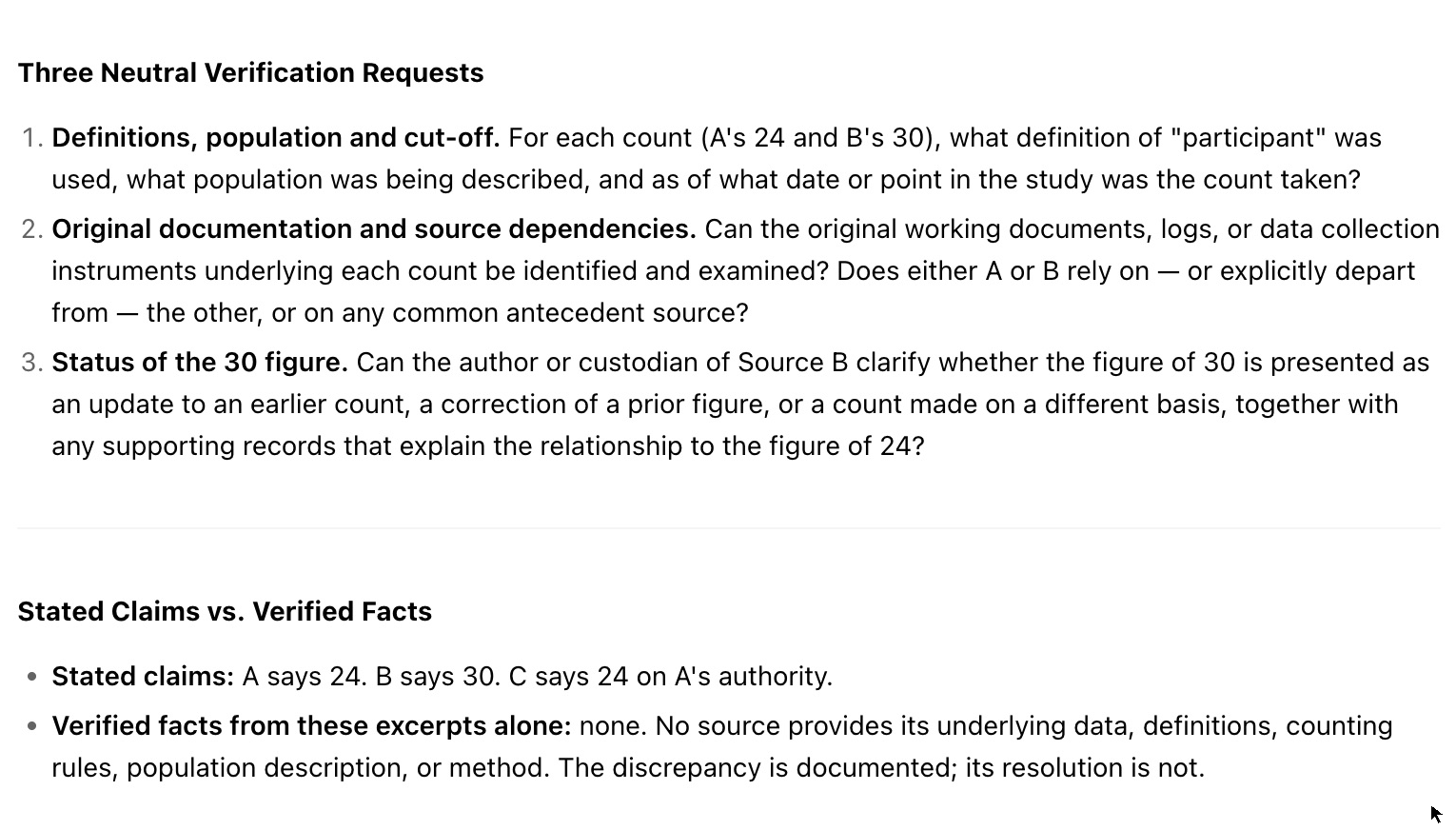
The corrected version asked:
- Ask how each source defined a participant, which population it counted and what cutoff it used.
- Request the original documentation and trace whether A and B share an earlier source or rely on one another.
- Ask what the figure of 30 represents, with supporting records if available: an update, a correction or a count on another basis.
The revised reply requested evidence. The participant count was still unresolved.
A prompt for reviewing conflicting sources
For a similar review, replace the excerpts in this suggested prompt with your own clearly labeled notes:
Review these fictional source notes in English, using only the excerpts:
A, October 1: 24 participants.
B, October 3: 30 participants; no explanation for the difference.
C, October 4: repeats and credits A; no independent observation.

Create a ledger with source, date, claim, independence and limitations. Mark relationships as unknown unless the excerpts establish them. Explain the unresolved conflict without choosing a count based on recency.

Do not assume matching populations, definitions, cutoffs or individual records. Give three neutral verification requests. Separate what each source says from what has actually been verified. Do not browse or invent missing evidence.
Keep the research boundary visible
We reviewed the supplied notes only. No real-world participant count was checked, and live search, retrieval and citations weren't tested. The result was a record of the disagreement and the questions needed to investigate it.
Compare the brief's dates and claims with the source notes before sharing it. Labels such as “independent,” “primary” and “confirmed” need evidence too.
If your source pack grows, use turning long documents and scattered notes into reports for the report and these Orlino tips for managing files and conversations. Keep unresolved counts in the brief when working in Orlino.
About this article
Published by Orlino, based on recorded product tests using fictional or supplied sample material. The results and limits described apply to those tests; features and model availability may vary by build and account. Screenshots are cropped to remove unrelated account details; retained text is unchanged. See our editorial process.
Try your next task in Orlino.
Bring your notes, files, and questions to Orlino. Choose the app for your device.