


Gemini 4 Neon: app access vs API billing — What the published evidence supports
The launch announcement is a dated source for Neon’s pricing and rollout. Use current account and model documentation for the price that applies to your request. Pricing can depend on the deployment, model version, account, and usage categories. For an actual budget, check each line item against metered units before committing spend.
A person reviewing documents by hand may care about which plan exposes Neon and how often they can select it. An engineering team needs an API project, model availability, a usage plan, and an allocation for retries and third-party tools. Put these requirements on separate rows before comparing totals.
Sources: Google’s Neon announcement · DeepMind’s Neon model card · Gemini API pricing documentation
Define the decision and a passing result
A small team compares ad hoc document review in the app with automatic processing from a service.
Write one line that explains what a reviewer must see to accept the result. For this case, check product, account, and metering scope. Keep the success rule in the worksheet next to the input revision. A person reading the record should be able to tell why an output passed without being told which model produced it.
Use a routine version of the access and billing map case first. Then change one condition to make the easy answer invalid. The example to look out for is this: an expense forecast adds API tokens to every manual app prompt and overlooks separate project fees. Write the expected response before trying either candidate. Use a second, held-out input if you adjust the prompt after looking at the first result.
Give each example a common denominator before comparing cost. Decide whether you are forecasting per attempt, per accepted result, per user, or per month. Keep the currency and units beside the number. In a shared spreadsheet, store per-million rates as separate cells and make the unit conversion explicit, so another person can audit the arithmetic.

Run the example on a fixed input
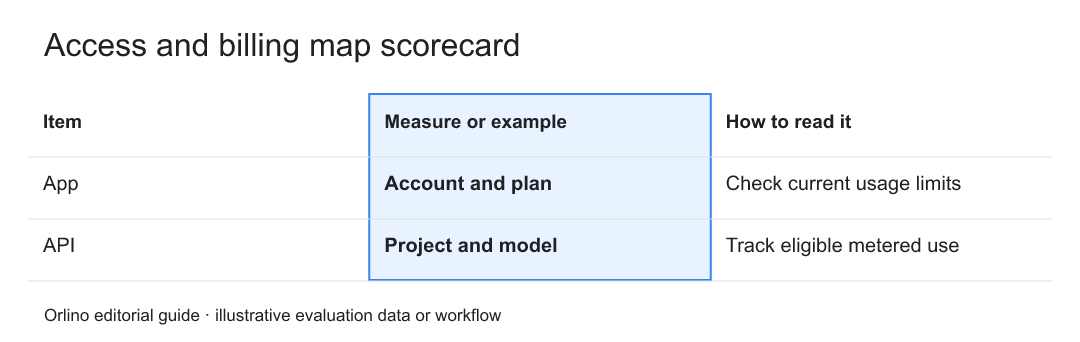
List who needs the model, whether requests originate in the app or code, and which account pays for each route.
For the app route, check model access and limits under the exact account and subscription. For an API deployment, record the billed project and endpoint, plus the applicable token categories. Seeing Neon in both places does not make the subscriptions interchangeable.
For the initial request, use this instruction as a starting point: “List who needs the model, whether requests originate in the app or code, and which account pays for each route. Explain which input supports each consequential claim or calculation. List any required checks you could not perform, and state what would let a reviewer finish the job.” Keep the instruction with the saved run so reviewers can distinguish a missed requirement from an unstated expectation.
Log usage at the level of a logical task and its individual attempts. Record the model identifier, endpoint, project, measured units, billing category, and rate date. Save the allocation rule you use for shared charges. A line item without observed usage belongs in an estimate, with its assumption visible. Wait for the project report before marking the expected amount as reconciled.
Include a low and high scenario by changing the two inputs most likely to move the bill. Keep the rate table fixed if you are testing changes in usage. If you are testing an announced price change, keep usage assumptions the same and date both schedules. This makes it easier to explain whether the forecast changed because of demand, rates, or something else.
Read the result and investigate misses
Choose the surface based on the workflow first. An occasional human-reviewed draft may fit the app. A scheduled job needs an interface that supports automation and observable usage. If you will combine both, record which budget covers each path so the same work is not charged twice in the forecast.
Keep a forecast and an observation column. In the forecast, multiply eligible units by the dated unit rate and account for likely repeats or fallbacks. In observation, preserve the actual bill and completion record. If the amount differs, look for a changed model, a cache eligibility difference, a larger output, or additional attempts before changing the whole forecast. Record the reason for each adjustment.
An expense forecast adds API tokens to every manual app prompt and overlooks separate project fees.
Compare the estimate with one completed reporting period. Make a note of charges that arrive late, credits that apply once, and spend that belongs to another model or project. Record any operational work your team spends on validation separately. A forecast that correctly predicts model spend can still understate the cost of serving the workflow if it omits this effort.
Decide whether to adopt the workflow
Use the app for the permitted interactive workflow and budget the API independently if automation is needed.
A low-cost request is useful when it completes the required job. Compare costs on accepted outputs of the same scope, and keep model charges distinct from the review or tooling time your team also pays for. A change in rates can alter the trade-off. Keep the usage assumptions and dated price reference so the calculation can be rerun later.
Name the person responsible for reviewing the result and the date you will revisit it. Keep one accepted and one rejected sample as references. A future model revision, revised billing entry, or change in the input mix is a good reason to run the checks again. When the evidence supports only a narrow change, document the task that qualifies and keep the existing process for the rest.
Conclusion
The app and API serve different workflows and have different billing surfaces. Google announced rollout to Gemini app Pro and Ultra subscribers and to the Gemini API. Confirm availability for your account and country.
Use the app for the permitted interactive workflow and budget the API independently if automation is needed.
Frequently asked questions
What should I check first for Gemini app versus API billing?
List who needs the model, whether requests originate in the app or code, and which account pays for each route.
How should I handle a failed example?
An expense forecast adds API tokens to every manual app prompt and overlooks separate project fees. Record the discrepancy and the relevant input or usage record. Require another run on a fresh case before changing the decision.
Can I apply these findings to another setup?
A low-cost request is useful when it completes the required job. Compare costs on accepted outputs of the same scope, and keep model charges distinct from the review or tooling time your team also pays for. A change in rates can alter the trade-off. Keep the usage assumptions and dated price reference so the calculation can be rerun later.
Keep reading
Gemini 4 Neon: Batch API pricing
Gemini 4 Neon: Batch API pricing. Work through rates, billing assumptions, and the checks to make before estimating costs.
Read article Gemini 4 NeonGemini 4 Neon vs Carbon cost per completed task
Gemini 4 Neon vs Carbon cost per completed task. Work through rates, billing assumptions, and the checks to make before estimating costs.
Read article Gemini 4 NeonGemini 4 Neon: context caching costs
Gemini 4 Neon: context caching costs — Explore context caching cost with a practical cache economics example, checks for common mistakes, and a decision guide.
Read article