


Gemini 4 Carbon and Gemini 4 Argon are different choices within Google's Gemini 4 family. Google's current positioning makes Argon the starting point for most software engineering and knowledge work, while Carbon targets especially demanding coding, reasoning, and research tasks. Google's Carbon availability announcement.
For your own workflow, start by deciding what makes the task difficult. A complicated-looking prompt may contain several straightforward steps. Another task may be short but require resolving a subtle contradiction. Those cases deserve different evaluations.
For specifications and access considerations, see the Gemini 4 model guide.
What are Carbon and Argon?
Google's model directory lists the API model codes gemini-4-carbon and gemini-4-argon. Both listings include text, image, audio, video, and PDF inputs. An application's interface and tools may expose only part of that capability. Gemini model directory.
Check the exact model and access route before comparing results. An answer from the Gemini app, an API application, and an agent environment may involve different tools, settings, and usage conditions.
This article offers a selection method. It does not report an independent head-to-head test.
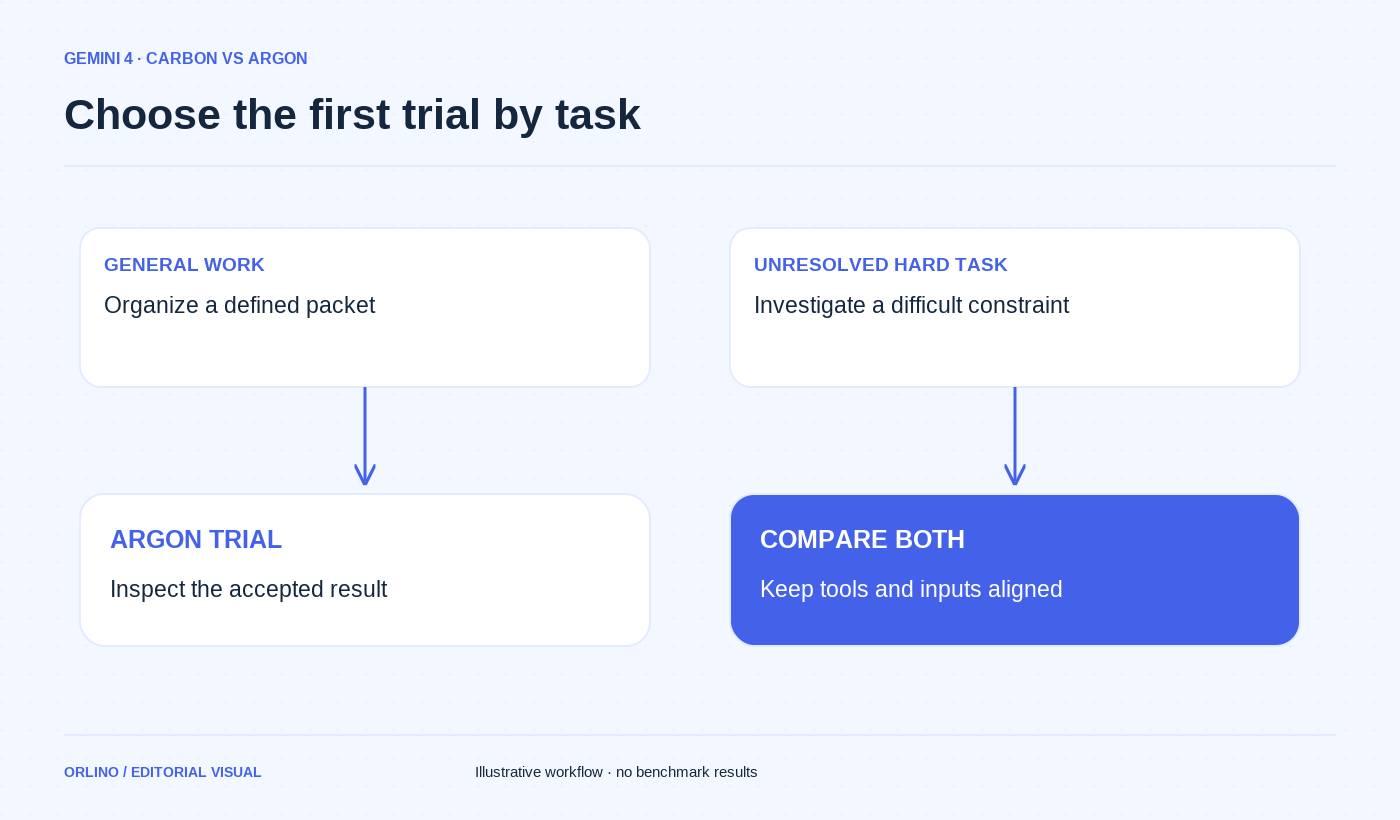
Use task requirements to choose your first model
The table below is an editorial evaluation plan, not a performance ranking.
| Your task | Suggested starting evaluation | What to inspect |
|---|---|---|
| Organize a defined set of documents | Argon | Coverage, omissions, and source references |
| Prepare a plan with explicit constraints | Argon | Whether dependencies and assumptions are clear |
| Investigate a difficult, unresolved defect | Compare Argon with Carbon | Whether the explanation survives reproduction |
| Explore competing research hypotheses | Compare Argon with Carbon | Evidence quality and treatment of alternatives |
| Produce a high-volume routine output | Include a cheaper model in the comparison | Accuracy at the required throughput and cost |
A routine task does not become a Carbon use case simply because it contains many files. First check whether the work can be divided into repeatable steps with reliable checks.
A coding example: explain the failure before changing code
Suppose a background job produces inconsistent results and the cause is unclear. Give the model the relevant code, a reproducible example, error output, and the checks it can run.
Ask for a diagnosis before a broad patch. The diagnosis should explain the observed behavior and identify evidence that would disprove it. Then evaluate whether the proposed change fixes the failure without damaging existing behavior.
If Argon reaches an acceptable result, you have a working baseline. If the failure remains unresolved, give Carbon the same materials and the specific unanswered questions. The useful comparison is whether the second approach resolves the problem with evidence—not whether it generates a longer explanation.
A Gemini 4 migration workflow supplies a bounded technical task for comparing compatibility reasoning.
A research example: separate extraction from judgment
Consider a report assembled from product documentation, release notes, and several dated announcements. Extracting dates and feature statements is one task. Deciding whether those statements support a recommendation is another.
You can use a baseline workflow to build an evidence table, then evaluate a more demanding model on the unresolved analysis. Require the second stage to cite the underlying sources and challenge assumptions in the table.
Using a second model does not make a report independently verified. The reviewer still needs to open the important sources and check that they support the claims being made.
Compare total usage, not just a token rate
Google's November 10 announcement notes that Carbon can use more tokens than Argon on difficult work. Its introductory pricing is also time-sensitive. A launch-price headline therefore should not stand in for a lasting cost estimate. Carbon announcement.
For each evaluation, record the model, configuration, total input and output usage, tool calls, retries, elapsed time, and manual corrections. Use the applicable rates on the date of the test.
A cost comparison is more useful when it ends with an accepted deliverable. If one run produces an incomplete report and another produces a correct result, comparing their first-response bills alone hides the difference that matters.
Read the context and output limits carefully
Google's detailed Gemini 4 documentation describes a unified context window shared by input and output. It also distinguishes the default synchronous output limit from extended output using long decode. A headline about a million tokens therefore needs to be read with its operating conditions. Carbon specifications and Argon specifications.
For planning, estimate the material the task needs, the space required for the response, and any intermediate information the application retains. A large source collection still benefits from a table of contents, dates, and a clear explanation of which documents are authoritative.
If you need an unusually long deliverable, check the endpoint and application limits before assigning the work. You may get a more usable result by requesting separate artifacts with clear interfaces: an evidence table, an analysis, and a final report. The reviewer can inspect each artifact and trace errors to the stage that produced them.
Use the Gemini 4 pricing guide to translate recorded usage into a dated cost estimate.
Distinguish multimodal input from media generation
Both detailed model pages list text, image, video, audio, and PDF input, with text output. That is relevant to tasks such as explaining a document or reasoning over supplied media; it should not be read as a promise that these specific models generate every media type they can ingest. Carbon model details and Argon model details.
Build the workflow around the output you need. If your task is to review a presentation, specify whether you want comments, an outline, rewritten text, or an edited file. The application needs appropriate tools to produce the final artifact. Confirm those tools separately from the model's input support.
For a media-based comparison, use the same source files and ask for traceable locations. A useful video analysis should identify the timestamps behind an important claim. A document analysis should point to the relevant pages or sections. This makes the result easier to check across both models.
Design a two-stage workflow without creating a dependency trap
A practical experiment is to use one stage for organizing evidence and another for difficult analysis. However, the second stage should be able to inspect the original material. If it receives only a flawed summary, it can inherit the first stage's omissions.
For example, ask Argon to build a source inventory and a list of open questions. Then evaluate Carbon on the hardest unresolved question with access to the original sources and the inventory. Request an explanation of any source it rejects or interprets differently.
Keep the handoff small and explicit: the goal, relevant materials, findings already verified, uncertain hypotheses, and checks still required. Avoid presenting all prior conclusions as settled facts. A useful second-stage result should identify what changed in the understanding of the task and what evidence supports that change.
This is a suggested workflow to test, not a report that such a division is always faster or cheaper. Compare it with a single-model run before adding the complexity to routine work.
Use a common review sheet
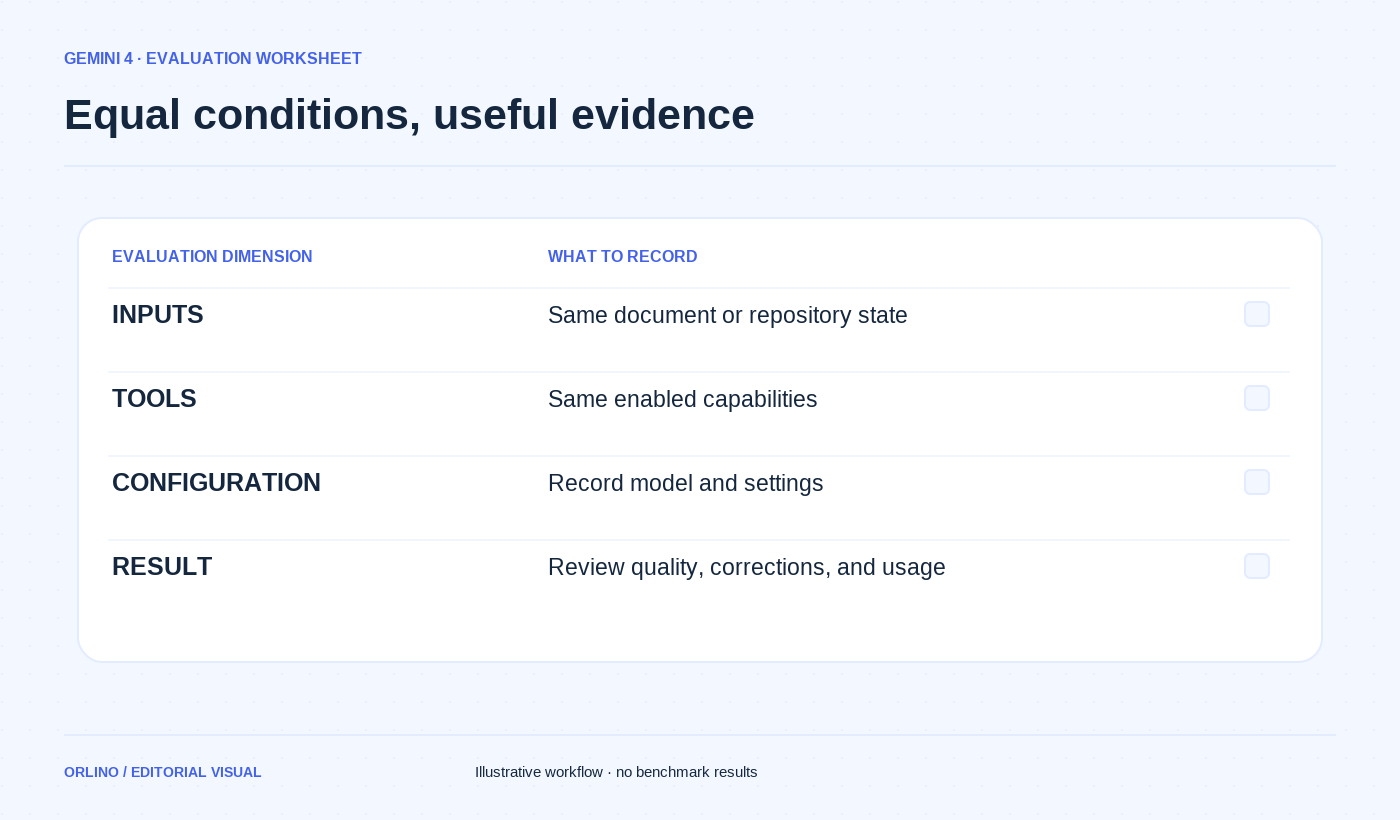
Give the reviewer the same questions for each run. For engineering work, record whether the failure was reproduced, whether the change was relevant, which checks ran, and what remains uncertain. For analytical work, record source accuracy, calculation consistency, omitted conditions, and the usefulness of the final recommendation.
A blank review sheet can look like this:
| Review item | Evidence to record |
|---|---|
| Task completion | Deliverable location and acceptance decision |
| Correctness | Defects found and their impact |
| Evidence | Source locations or executed checks |
| Usage | Model configuration, tokens, tools, and retries |
| Review work | Corrections and time needed after the run |
| Remaining uncertainty | Questions that could change acceptance |
Do not turn every observation into a single score unless the weighting reflects your actual decision. A model that produces attractive formatting while missing a critical requirement should not win through an arbitrary average.
Separate model choice from agent-environment choice
An agent environment can affect what the model is able to attempt. Repository access, search tools, browser controls, document editors, and approval steps are part of the surrounding system. Compare those capabilities when choosing a complete product.
If your goal is a model comparison, keep the environments similar. If your goal is a product choice, compare the complete workflows and say so. Both experiments can be useful, but they answer different questions.
Also record execution constraints. A run that stops because a tool is unavailable is different from a run that has the evidence but reaches an incorrect conclusion. Understanding the failure helps you decide whether to change the model, the tools, or the task design.
Revisit the choice after a pilot
Once a limited evaluation is complete, decide what to preserve. You might keep Argon for a defined class of work, route a small set of difficult investigations to Carbon, or decide that the current evidence does not justify a change.
Record the scope of that decision. Results from source-based research should not automatically become a policy for coding, and a coding investigation should not establish a general preference for all document work.
Repeat the evaluation when material conditions change: the task, source quality, available tools, relevant model version, or billing terms. A useful selection policy includes a reason to reconsider it.
Which Gemini 4 model should you choose?
Start with a defined task and a clear acceptance standard. Evaluate Argon as the baseline for general work. Compare Carbon when the task presents a specific unresolved reasoning or engineering challenge.
Keep a record of why you switched and whether the switch helped. That record becomes more useful than a permanent rule that one model should always handle research or coding.
If you plan to use a third-party workspace, confirm its exact model listing and supported tools separately. A product offering multiple AI models does not necessarily expose every Gemini version or every input type.
Conclusion
Gemini 4 Carbon and Argon should be compared through the work you need to complete. Use Google's positioning to choose a starting point, then make the task, tools, budget, and acceptance checks explicit. Pay attention to the conditions behind context limits, media support, and introductory prices when designing that evaluation.
For general work, an Argon baseline can show whether an escalation is needed. Test Carbon against a specific unresolved challenge and inspect whether the result improves. Preserve the source material and review record so your decision rests on a repeatable workflow with a clear scope.
FAQ
What is the main difference between Gemini 4 Carbon and Argon?
Google positions Carbon for its most demanding reasoning and technical work, while Argon is the more efficient Gemini 4 option. Treat that as a reason to evaluate different task roles, then use your own completed assignments to decide whether the distinction matters. Official Argon overview.
Is Carbon always the better choice for coding?
A model choice depends on the coding assignment, available tools, acceptance standard, and operating budget. Use a reproducible task and inspect the result. A successful run on one difficult bug does not establish which model will work best across routine changes, reviews, and migrations.
Can both models analyze PDFs, images, and video?
Google's detailed specifications list these input types for both models. Your application still needs to accept and pass the relevant material to the model. Check the interface and file conditions before planning the workflow. Carbon specifications; Argon specifications.
Does multimodal support mean Carbon generates audio or video?
The detailed Carbon listing describes text output. Input support and output generation are different capabilities, and an application may combine several models or tools in a media workflow. Check the specific component producing the requested output. Official Carbon model details.
Do both models cost the same for a completed task?
Equal headline token rates, when applicable, would not imply equal task bills. Token usage, reasoning, retries, tools, and billing conditions can differ. Use the current applicable rates and the full resource record from each run rather than extending a launch-price headline indefinitely.
Should I use Argon first and Carbon as a reviewer?
That is a workflow worth testing when you have a meaningful unresolved question. Give the reviewer the original evidence and ask it to challenge assumptions. Compare the two-stage result with a simpler workflow, including the extra usage and human review it requires.
Can I rely on older launch articles for current availability?
Use the newest applicable official access information and your account's actual model listing. A model can move from a limited rollout to broader access, while individual products and regions may still differ. Record the date and access route used in your evaluation.
Are all Gemini 4 capabilities available in Orlino?
Verify the current application listing and tool support. This article describes model selection and an evaluation method; it does not establish that Orlino exposes Carbon, Argon, or every capability listed in Google's API documentation.