


Start with Claude Opus 5.5 for a general coding or knowledge-work evaluation. Consider Claude Fable 5.2 when the task remains difficult after you have clarified the requirements and tested a reasonable Opus setup. That follows Anthropic's own model-selection guidance, rather than assuming the higher-priced model should handle every request. Claude model overview.
The decision becomes clearer when you compare the finished work: correctness, review effort, cost, and the time needed to reach an acceptable result.
For specifications and access considerations, see the Fable 5.2 model guide.
Fable 5.2 and Opus 5.5 at a glance
The following figures describe the published Claude API offerings checked on November 11, 2026. They are not prices for a Claude app subscription or an Orlino plan.
| Published specification | Fable 5.2 | Opus 5.5 |
|---|---|---|
| Claude API model ID | claude-fable-5-2 | claude-opus-5-5 |
| Context window | 1M tokens | 1M tokens |
| Maximum output | 128K tokens | 128K tokens |
| Listed input price per million tokens | $8 | $4 |
| Listed output price per million tokens | $40 | $20 |
Anthropic's model comparison. These headline rates do not represent every billing condition; check the applicable pricing terms before estimating a production workload.
The shared context limit does not tell you which model will solve your particular problem. A large input allowance is useful only if the resulting work is accurate and reviewable.
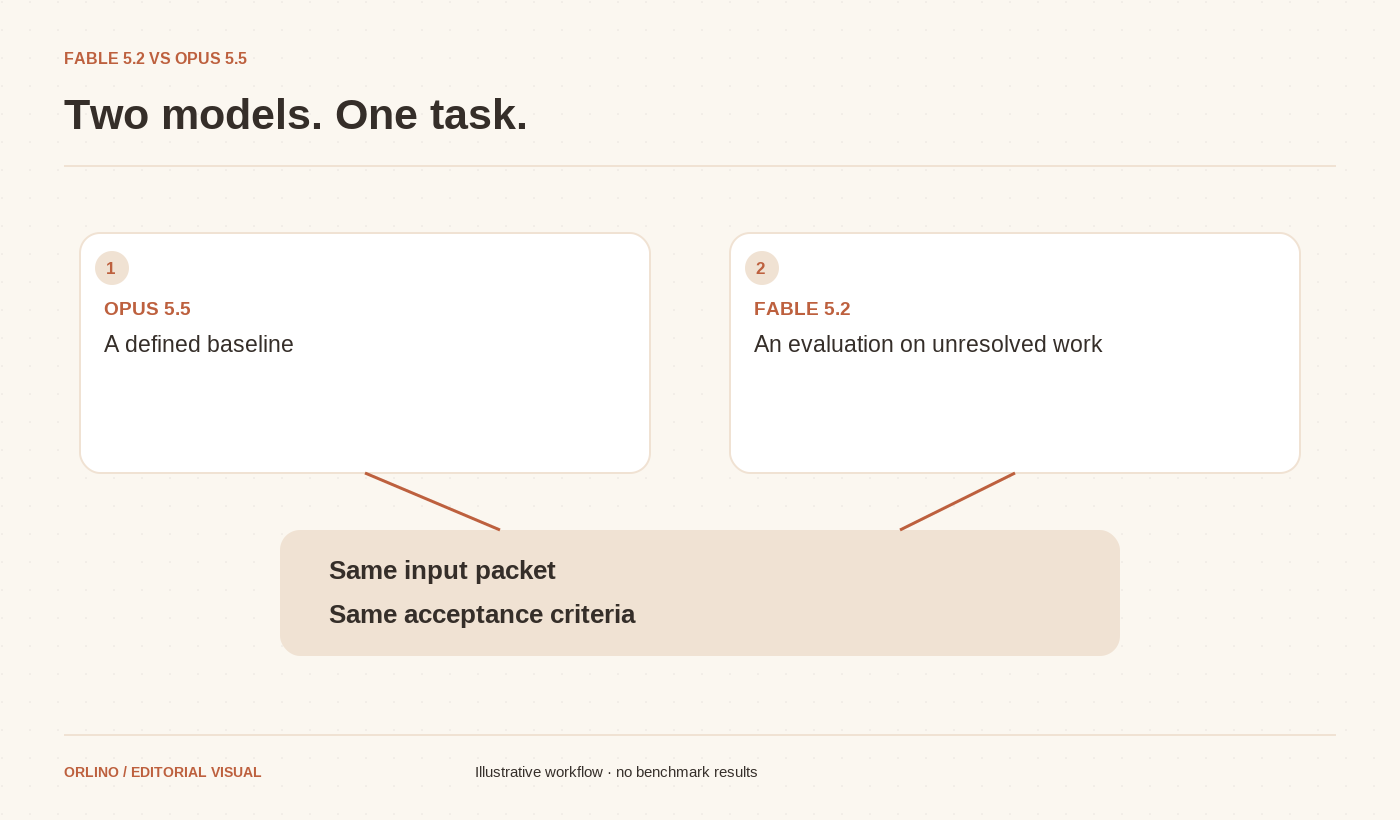
Compare cost per accepted result
Here is a hypothetical API calculation using the listed input and output rates above. It assumes 100,000 billable input tokens and 10,000 billable output tokens, with no caching discounts, tool charges, special processing options, or other adjustments.
- Fable 5.2:
(0.1 × $8) + (0.01 × $40) = $1.20. - Opus 5.5:
(0.1 × $4) + (0.01 × $20) = $0.60.
Those are illustrative token charges, not measured costs for a real task. The models may use different numbers of tokens, require different numbers of attempts, or leave different amounts of manual work.
Record the total cost of producing an accepted result. Include retries and revisions in that record. Keep human review time alongside the bill instead of assuming a cheaper request always produces a cheaper workflow.
Use a task that exposes a meaningful difference
A short factual question is unlikely to tell you much about an extended engineering workflow. Choose an assignment with a result you can inspect and a failure mode you care about.
For a coding comparison, provide both models with the same repository snapshot, issue description, tool permissions, and test commands. A useful assignment might require tracing an error through several modules while preserving existing behavior.
For analytical work, give both models the same source documents and ask them to produce a recommendation with supporting evidence and unresolved questions. Check the reasoning against the originals, not just the quality of the prose.
Do not publish a winner based on one convenient example. A single task can inform your next experiment, but it cannot establish which model is better across unrelated workloads.
A Fable 5.2 code-review guide gives this comparison a concrete engineering task and inspectable findings.
When is it reasonable to move from Opus to Fable?
Consider an escalation when you can describe what the current result is missing. Examples include an unresolved contradiction in the evidence, a diagnosis that fails to explain the observed behavior, or a proposed change that repeatedly breaks an important check.
Before switching, make sure the model had the necessary files and a clear acceptance standard. Missing context is not a model comparison.
When escalating, pass along the original task, the failed checks, and the uncertain points. Treat the previous answer as a hypothesis to examine, not a conclusion the next model must defend.
Keep the evaluation fair
There are two useful comparisons. A controlled comparison holds the task and configuration as similar as possible. A workflow comparison lets each model use a suitable configuration within the same time or cost budget.
State which comparison you are running. If one model receives more tools, a larger budget, or substantial human guidance, disclose that difference. Otherwise the result may say more about the setup than the model.
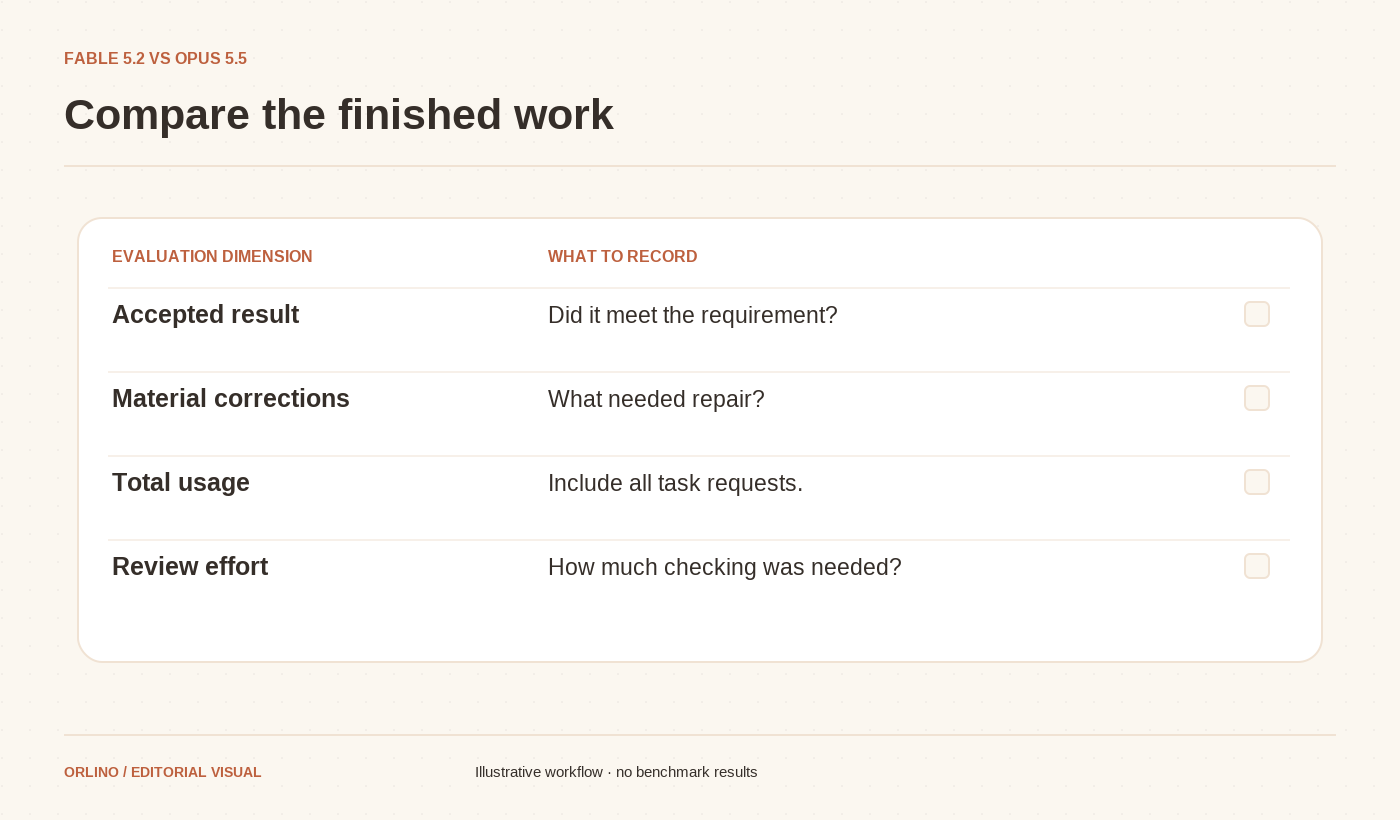
A small review table can track whether the deliverable works, what the reviewer had to correct, which checks passed, and what remains unverified. Use pass conditions defined before reading the answers.
Build a small evaluation set from your actual work
Create a set of representative tasks rather than searching for a single impressive demonstration. Include assignments that you perform frequently and a few difficult cases that cause substantial review work. Keep private or sensitive material within an environment authorized for it.
A useful coding set can contain a focused bug fix, a change spanning several modules, and an investigation where the cause is uncertain. A knowledge-work set can contain a source-based memo, a document comparison, and a calculation that must follow specific definitions. These are examples of task categories, not a prescribed benchmark.
For each task, save the starting materials and expected deliverables. If the same assignment is rerun later, use the same version of the input or record what changed. Otherwise you may attribute a difference in the materials to a difference between Fable 5.2 and Opus 5.5.
Use the Fable 5.2 pricing guide when the evaluation needs separate estimates for standard, fast, batch, or cached requests.
Define acceptance before seeing either answer
Decide what the reviewer needs to accept the work. For a patch, acceptance might require reproducing the failure, passing relevant checks, and preserving the public interface. For a report, it might require correct source references, consistent numbers, and explicit treatment of missing evidence.
Separate requirements that must pass from preferences. A formatting preference should not outweigh a calculation error. Equally, a correct result delivered in an unusable format may still need revision before it becomes a useful business output.
Use concrete observations in the review record. “The second table uses a different date range from the source” tells the next reviewer what failed. An unexplained quality score gives less information about how to improve the workflow.
Compare settings and permissions openly
Anthropic lists different default effort settings for the models: high for Fable 5.2 and medium for Opus 5.5. A default-versus-default run therefore should be described as a comparison of those configurations, with the settings recorded. Fable 5.2 comparison table.
If you tune the settings, save the configuration with the results. Do not assume that identically named settings imply identical amounts of computation across models. Your record should make the setup reproducible and the comparison understandable.
The same applies to permissions. If one run can execute code and the other can only read a prompt, their outputs reflect different environments. Give both a suitable tool setup or explicitly state that you are comparing complete products rather than isolated models.
A hypothetical routing decision
Consider a development team using a baseline model to investigate a regression. The first attempt identifies a plausible cause, but the proposed patch does not pass the existing check. The team has three useful next actions: clarify the requirement, gather missing diagnostic evidence, or escalate the unresolved analysis.
Before choosing Fable, inspect the failure. If the required configuration file was absent, supply it and rerun the baseline. If the explanation contradicts a reproduced result despite having the necessary evidence, an escalation is a more informative test.
Give the second model the original assignment and the failing evidence. Ask it to examine the diagnosis independently. A successful escalation would explain the contradiction and produce a result that meets the same acceptance conditions. This is a proposed decision process; it does not claim that either model solved this example.
For repeated work, route by task category and observed failure pattern. A model that helps with one difficult investigation may still add little value to a routine transformation that your baseline already handles well.
Keep financial and operational measures separate
Track API charges as one measure and reviewer time as another. You can combine them into a business cost only after choosing an explicit value for that time. Avoid hiding a subjective hourly assumption inside a claim that a model is cheaper.
For example, a review record could contain the billable token totals, separately charged operations, number of retries, minutes spent checking the work, and whether the deliverable was accepted. Leave the values as actual observations from your evaluation rather than filling the table with invented results.
Also distinguish time to the first response from time to a finished result. A quick initial answer may require several revisions; a longer run may return a more complete artifact. Measure the milestone your workflow actually needs and disclose any time limit imposed on the runs.
Handle inconclusive results
Some comparisons will not produce a clear preference. Both models may satisfy the requirement, fail for different reasons, or perform differently across tasks. Preserve that result instead of forcing a single winner.
When both pass, the lower-cost or simpler setup may be sufficient. When neither passes, inspect whether the task lacked evidence or needed a deterministic tool. When results vary by category, use that distinction to guide a limited routing policy and continue monitoring it.
Repeat a meaningful sample when reliability matters, keeping inputs and settings documented. A second run can reveal instability, but a small set of repeats still does not establish a universal performance rate. Describe the size and scope of your evidence with the conclusion.
Plan an upgrade that can be reversed
Before switching an established workflow to Fable 5.2, preserve the current prompts, configuration, and accepted example outputs. Test the new setup against the cases that matter most to your team.
Use a limited rollout and keep a record of new failure types, corrections, and costs. If the new setup does not meet the acceptance standard, return to the known baseline while investigating. A reversible change helps you learn from the evaluation without making every production task part of the experiment.
Which model should you choose?
Choose Opus 5.5 when it meets your acceptance standard with manageable cost and review effort. Evaluate Fable 5.2 when a harder task has a specific unresolved problem and the additional cost can be justified by a better result.
If neither produces acceptable work, improve the task design or change the workflow. More attempts at an ambiguous request are not a substitute for missing evidence or an unclear goal.
When comparing a direct API setup with a multi-model application, also check the available version, tools, and billing route. Orlino's model overview is a starting point for that product-level check; the API figures in this article do not describe Orlino's pricing.
Conclusion
The Fable 5.2 versus Opus 5.5 decision should follow the task and the evidence from your workflow. Use Opus as a sensible starting evaluation, define what acceptance requires, and test Fable on specific challenges that remain unresolved. Record the configuration, tools, usage, and reviewer corrections so the comparison can be understood and repeated.
A useful outcome may be a selective policy: one setup for routine work and another for demanding investigations. Keep that policy open to revision as your tasks, model options, and costs change. Choose the arrangement that produces dependable, reviewable work within your constraints.
FAQ
Is Fable 5.2 better than Opus 5.5 for every task?
A universal claim would require evidence across many workloads and configurations. Your decision should be narrower: whether Fable improves the assignments your team needs to complete. Test those assignments and inspect the accepted deliverables, including the work required to correct them.
Which model should I try first?
Anthropic's model overview recommends Opus 5.5 for most workloads, with Fable for more demanding work when evaluations justify it. For your pilot, make the requirements and available evidence clear before treating a weak answer as a reason to escalate. Official model guidance.
Does Fable cost exactly twice as much per task?
The listed standard input and output token rates in the comparison table are twice the corresponding Opus rates. Actual task cost also depends on token usage, caching, retries, tools, and billing options. Two models can consume different resources on the same assignment, so measure the complete run.
Should I use the same prompt for both models?
An identical task prompt is useful for a controlled comparison. You can also evaluate model-specific prompts under an equal budget, but record those differences. Keep the assignment, source material, and acceptance conditions consistent so you understand what produced the result.
Are benchmark results enough to choose a model?
They can help identify a model to evaluate, but they do not establish its performance on your files, tools, and requirements. Use representative tasks and inspect failures that matter to your workflow. Publish a task-specific conclusion when your evidence is task-specific.
Should one model review the other model's work?
A second review can suggest additional checks or expose inconsistencies. It does not make the output independently verified. Reproduce failures, run relevant tests, open important sources, and inspect calculations using tools and evidence outside the generated explanation.
Does an API price comparison also compare app subscriptions?
No. Direct API billing, consumer plans, and third-party workspaces can package usage differently. Compare the billing route you intend to use and the actual features available there. Confirm current terms before converting a token-rate example into a purchasing decision.