


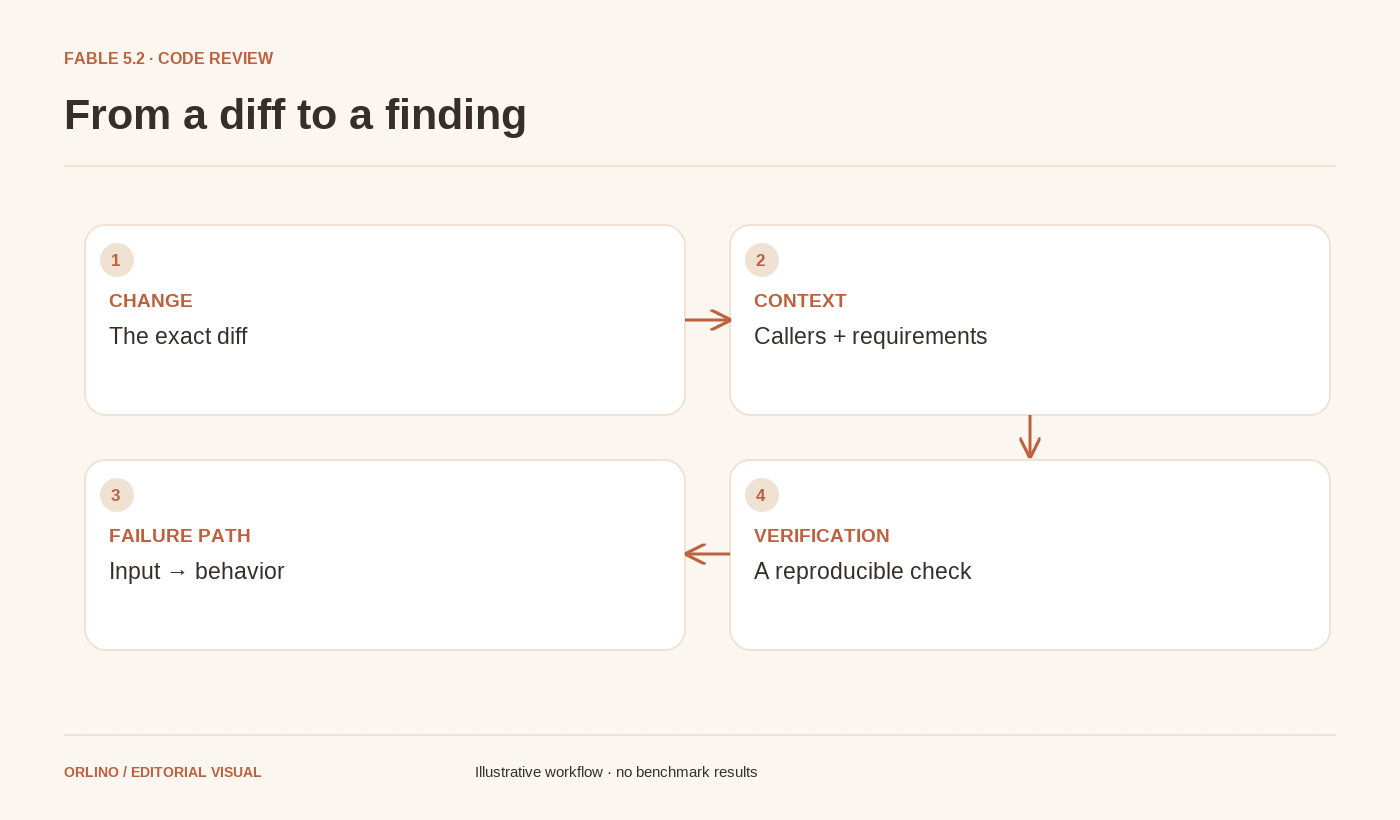
Use Claude Fable 5.2 for code review by defining the change under review, providing the surrounding code and requirements, and asking for findings that another developer can reproduce. A useful review identifies a concrete failure, explains why the change can cause it, and points to the affected code.
Anthropic positions Fable 5.2 for demanding coding and extended agent work in its model overview. That makes it a candidate to evaluate on difficult reviews. It does not establish that any generated finding is correct or that a model has executed a proposed test.
The workflow below is an editorial review method. The example is hypothetical, and no benchmark result or customer outcome is claimed.
For specifications and access considerations, see the Fable 5.2 model guide.
Start with the purpose of the change
A review is easier to conduct when the intended behavior is explicit. Provide the issue, acceptance conditions, and the reason for the change alongside the diff. Explain any behavior that must remain compatible, such as a public response format or a stored-data convention.
Also identify what is outside the assignment. A focused review of a pagination fix should not turn into a speculative redesign of the entire service. If nearby code creates a real problem for the change, explain the connection rather than expanding the scope without a reason.
Ask the model to restate the intended behavior briefly before evaluating the implementation. This creates an early opportunity to correct a misunderstanding that would otherwise affect every finding.
Prepare a review packet
A useful packet includes the diff, relevant callers, tests that exercise the behavior, and a small set of representative inputs. When a failure depends on configuration, include the relevant settings with secrets removed.
| Material | What it helps establish |
|---|---|
| Issue and acceptance conditions | Intended behavior |
| Diff and base revision | Exact change being assessed |
| Relevant callers and types | How the changed code is used |
| Existing tests | Current behavioral expectations |
| Reproduction or sample input | Conditions behind a suspected failure |
| Environment notes | Runtime and configuration assumptions |
Keep the packet tied to a specific revision. If the developer pushes another change during review, record which findings still apply. A comment based on an older diff can become misleading even when it was initially correct.
Ask for findings with evidence
The following prompt is a starting template. Adapt its checks to the actual project rather than treating every category as mandatory.
Review this change against the supplied requirement and base revision.
Focus on defects introduced or exposed by the change.

For each finding provide:
- A concise description of the failure
- The affected file and smallest relevant line range
- The input or execution conditions needed to trigger it
- The expected and actual behavior
- Evidence or a reproducible check

Separate confirmed findings from questions needing more context.
Do not claim a command ran unless execution results are available.
This format makes findings actionable. It also discourages vague comments that identify a theoretical concern without showing how it relates to the code under review.
When a review becomes a larger investigation, use the Fable 5.2 checkpoint workflow to preserve the open questions.
Trace the changed behavior through its callers
A local function can look correct while violating a caller's assumption. Ask the reviewer to follow important inputs and outputs across the relevant boundary. That might involve a route handler, serializer, database query, or downstream consumer.
Keep the trace bounded. The goal is to establish the conditions behind a finding, not to narrate every line of the repository. A concise path from input to failure is more useful than a broad tour of unrelated components.
When the environment cannot retrieve the required caller, leave the question open and name the missing material. A finding should not be presented as confirmed if it depends on an assumption about code that was never inspected.
Worked example: a pagination boundary
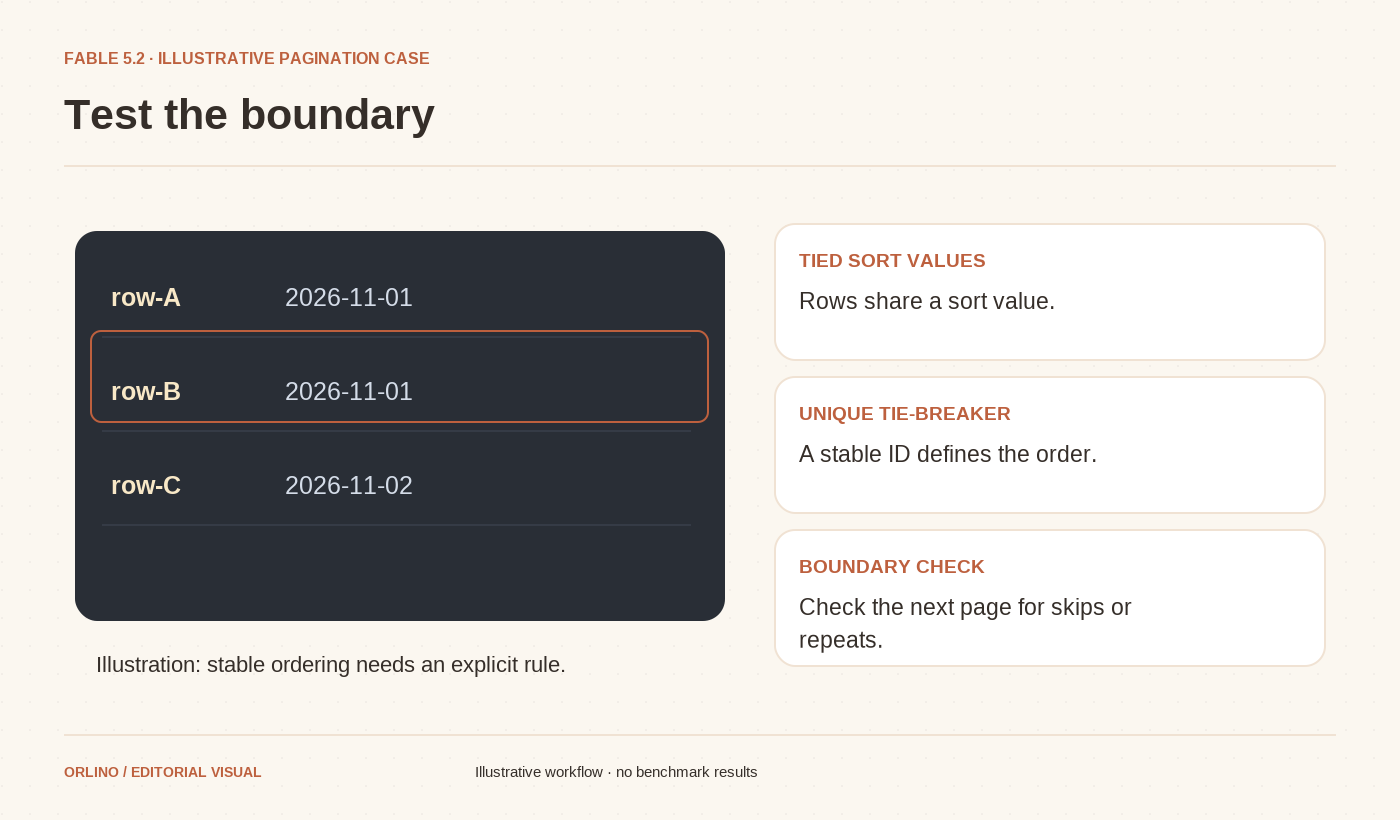
Imagine a hypothetical change that replaces an inclusive cursor boundary with an exclusive one. The developer intends to avoid repeating the last item on the next page. A reviewer should examine how the cursor is created, which ordering field is used, and whether that field is unique.
A possible question is what happens when several records share the same ordering value. That question becomes a finding only if the code and requirements show a concrete missing or duplicated-record case. The reviewer should specify the records and request sequence needed to demonstrate it.
The output should connect the issue to a behavior the team cares about. A label such as “pagination might be broken” is less useful than a reproducible example showing an omitted record under the intended sorting rules.
Choose checks that could disprove the finding
Ask for a check that would fail if the suspected defect exists and pass under the expected behavior. Keep the original failing condition available so the developer can repeat it after a fix.
For pagination, meaningful cases might include tied sort values, an empty result, a final partial page, and a continuation after an inserted record. Which cases belong in the change depends on the requirements and consistency model of the system.
Avoid treating the presence of a new test as proof that it is useful. A test that mirrors the implementation can pass while preserving the same mistake. Review whether the assertion expresses the intended behavior independently.
If reviews will run repeatedly, the Fable 5.2 pricing guide helps budget for corrections and verification as well as the first response.
Separate defects from optional improvements
A review can contain useful suggestions that do not block acceptance. Keep those suggestions distinct from defects. The developer should be able to tell whether a comment describes incorrect behavior, a missing requirement, or a preference about organization.
For a confirmed defect, explain impact under stated conditions. For an unresolved concern, identify the evidence needed to decide it. For an optional improvement, describe the benefit without presenting it as a requirement the author never agreed to meet.
This separation helps keep the review focused. It also makes later evaluation of the AI workflow more meaningful: you can count accepted defect reports without inflating the record with stylistic observations.
Use execution results carefully
A coding environment may allow the model to run commands, but that capability belongs to the surrounding application and its permissions. Confirm the tools available for the review before asking for executed verification.
Save the command, relevant environment, exit result, and useful output. If a check could not run because a dependency was missing, state that limitation. An explanation of what a test would do is not an execution result.
Run only the checks needed to establish the finding and verify the affected behavior. Broader checks are appropriate when the change reaches shared components or reveals another material uncertainty. Repeating unrelated checks adds cost without necessarily strengthening the conclusion.
Make the review handoff easy to use
Lead with confirmed findings and their impact. Include code locations and reproduction steps near each finding, followed by unresolved questions and any optional suggestions. Keep a short summary of what was actually inspected and executed.
If no actionable findings were established, say what the review covered and what remained outside the available evidence. That is more informative than declaring the entire system safe or bug-free.
The developer should be able to take one finding, reproduce it, make a focused correction, and rerun the relevant check. A review that requires reconstructing the model's conversation before taking action is harder to maintain.
Re-review the fix against the same requirement
When the author provides a correction, inspect the affected path and rerun the check that demonstrated the issue. Confirm that the fix addresses the original failure and preserves the important neighboring behavior.
Do not assume the revised diff is correct because it resembles the proposed solution. The author may choose a different implementation that still satisfies the requirement. Evaluate the behavior and constraints rather than requiring an exact textual match.
Preserve the original finding and its resolution in the review record. This gives you a concrete basis for assessing whether Fable helped identify a real defect and whether the handoff saved or created work.
Decide when Fable adds value to review
Evaluate the workflow on representative changes. Record findings accepted by developers, false positives, meaningful defects missed in later review, usage, and time spent verifying the comments. Define the scope of any conclusion from that sample.
A more expensive model may be worth testing on complicated changes with subtle interactions. Routine changes may already be handled adequately by an existing toolchain and reviewer. The Fable versus Opus comparison describes how to assess that trade-off.
For the model's role and access routes, consult the Fable 5.2 guide. Repository access, execution permissions, and merge authority should remain explicit in whichever application you choose.
Conclusion
A useful Fable 5.2 code review connects a requirement to a specific change, a reproducible concern, and evidence that can be checked. Start with a well-defined review packet, trace relevant callers, and separate confirmed defects from questions and preferences. Preserve actual execution results when tools are available.
Evaluate the workflow through findings that developers can act on and the work required to verify them. Keep final acceptance and release decisions with the responsible team. The result should be a focused engineering handoff that improves understanding of the change and makes the next action clear.
FAQ
Can Fable 5.2 replace a human code reviewer?
Use it as part of a review process with explicit verification and ownership. A generated finding can be wrong or incomplete, and the application may lack important context. The responsible reviewer should inspect consequential claims and decide whether the change meets the project's requirements.
Should I provide the entire repository?
Provide the materials needed to understand the change and its callers. Start with the diff, requirements, relevant types, and tests, then expand when a finding depends on another component. Large input capacity does not guarantee that every unrelated file will improve the review.
What makes an AI review finding actionable?
It identifies a concrete failure, the affected location, the conditions that trigger it, and the expected behavior. A reproduction or meaningful check helps the developer verify the claim. Keep unresolved assumptions visible instead of describing a hypothetical concern as a confirmed defect.
Should the model fix the code during review?
Only when that is part of the assignment and permitted by the environment. A review-only task can be valuable without edits. If a fix is authorized, preserve the original finding, scope the change, and verify it against the same behavioral requirement.
What if the model cannot run the tests?
Record which checks were unavailable and why. The model can still suggest a reproduction, but it should label it as proposed. An authorized developer or suitable environment must execute the check before its result is treated as verified evidence.
How do I measure review quality?
Track accepted findings, false positives, later-discovered misses, verification effort, and usage across representative changes. Explain the sample and scope. A few successful comments should not be presented as proof of a general defect-detection rate.
Is Fable always preferable to Opus for review?
Test both against the changes you actually review, with comparable context and tools. Choose based on accepted findings and total workflow cost. More difficult cross-component changes may justify an escalation, while straightforward reviews may not require a different model.