


We tested two fictional scoring systems. The second changed the token type and introduced a negative value, so copying the first example's arithmetic would not produce the right answer.
Keep the sequence visible
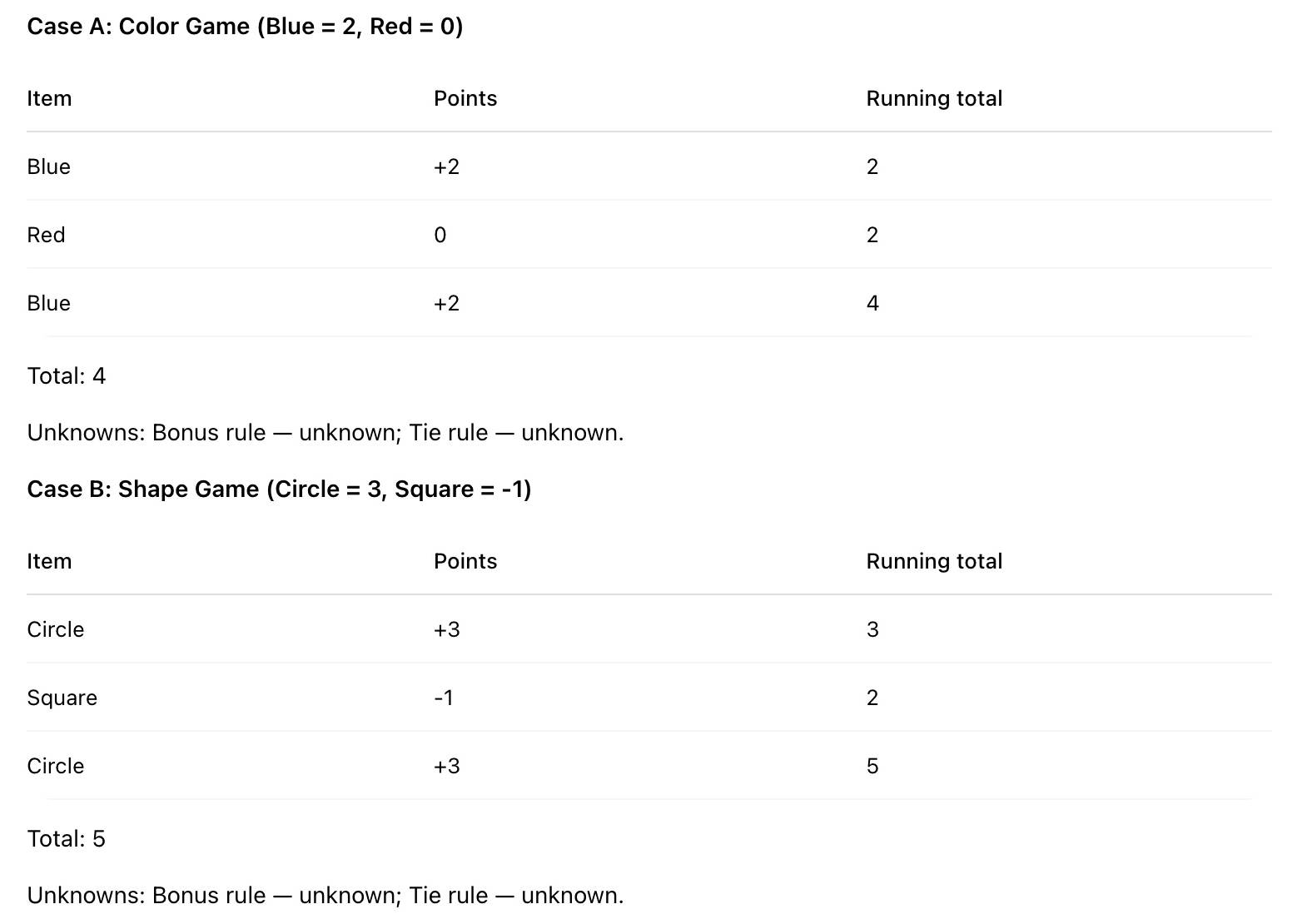
The first rule awarded two points for each Blue token and zero for each Red token. For Blue, Red, Blue, Orlino showed running totals of two, two and four. The final score was four.
The independent shape game awarded three points for a Circle and negative one for a Square. Circle, Square, Circle produced running totals of three, two and five. The deduction remained visible in the middle row rather than being ignored or converted to zero.
Neither brief supplied bonus or tie rules. Both outputs kept those rules Unknown. The response did not assume there were no bonuses just because none had been described, or invent a tie-breaker to complete the design.
Ask for the calculation before design advice
Select Game Designer in a new Orlino task. Our examples used GPT-5.6-Sol in desktop version 0.0.6.
Check this fictional scoring rule: [item-to-points mapping]. Sequence: [ordered items]. Return a table with Item, Points and Running total, followed by Total and Unknowns. Bonus and tie rules are unknown. Preserve the sequence. Do not add mechanics, fairness claims or implementation details. Reply in English in chat; do not execute code or write files.A short sequence is easy to verify by hand. Include a zero-value or negative-value item when the real rule contains one, so the example exercises more than repeated addition of the same reward.
Review the rule and the result separately
Compare every point value with the supplied mapping, then add each row to the previous total. A correct calculation says the example follows the rule. It does not establish that the game is fair, engaging or balanced across longer play.
Both scoring tables remained available after reopening. A playable game and playtest results were outside this calculation.
Check a game scoring example in Orlino before adding more rules to the design.
About this walkthrough
Published by Orlino Editorial from two recorded fictional chat cases in Orlino 0.0.6 with GPT-5.6-Sol on October 21, 2026. The starting prompt is adaptable. These examples establish only the described scope, not general model reliability. Screenshot text is unchanged; account controls are outside the crop. See our editorial process.
Try your next task in Orlino.
Bring your notes, files, and questions to Orlino. Choose the app for your device.